Archive for the '400 thoughts' Category
July 4th, 2008 by elie
The recipe for aliyah success is a complicated set of characterstics; not because what is required but because I think attaining what is required is seeded way before making aliyah.
I’ve mentioned creativity, open-mindedness and flexibility before. One other major ingredient in this recipe, I’ve discovered, is direction.
Now, direction is an ingredient for many successes: making the move from high school to college, making the move from college to being employed, independent and stable. Transitioning to the next stage of life, whichever that is, is a lot smoother if you know where you’re going, why you’re doing it and that you’re equipped.
Which is why, I find it funny when Israeli-borns are so impressed that in three years, I moved here, started a masters, got a steady job, got married, settled in a suburb, etc. They say, “Wow, I know tons of Israelis who haven’t gone that far…” Right. Because direction matters whether you’ve lived here all your life, or just for a few years.
A lot of people make aliyah because they lack direction. Some work it out, some don’t. Some people don’t make aliyah because they have direction and know it’s not in Israel; that’s not being anti-Israel, it’s honesty.
I also wonder if Israeli-borns view us as wealthy Anglos who obviously got this far because we had money coming into it. It couldn’t be more false; we were/are opportunists who are liberal when there is a knock at the door. Anyone can do that too, whether new oleh or vatik.
Opportunism, creativity, open-mindedness, direction, flexibility and honesty. It all works in hand-in-hand when you make it work that way.
June 2nd, 2008 by elie
Last night, I completely forgot it was the evening of Yom Yerushalayim (Jerusalem Day). If I had remembered, I might have at least considered going down to the Old City to pay my respects and tributes.
What is it about modern Jerusalem that makes it so easy to forget? Is it the modernity in it? Is it the politics? The imperfection?
Part of it for me is the political implications. Sure, 41 years ago today, Jerusalem was ‘reunited’ - on paper. In some of our hearts. In some of our minds.
Part of it for me is the general apathy. The municipality tries to make the city more attractive, tries to find the bridge between ancient and holy, and modern and successful. It’s not working though. People are leaving. The city is becoming more Charedi, Arab and touristy.
Part of it for me is the letdown. For the first 12 years of my life Jerusalem was a holy city, untouched by rubbish. When I visited here for the first time, I was severely disappointed. Blame the high expectations on my diaspora yeshiva education, on my enthusiastic tefillot, on my imagination, but the fact is - it’s just not even close to the Jerusalem I thought I was supposed to long for.
I suppose the main thing about a reunited Jerusalem of 41 years is the attainment of the Old City. Maybe later I will go down and there and say a word or two. Or maybe I won’t.

May 26th, 2008 by elie
Can a Memorial Day be happy? Isn’t the essence of the concept to reflect, to introspect, to national-spect? I find that with national-specting comes a bit of shame, a dash of pride and a whole lotta tears either way.
To some, Israeli and American Memorial Days might be categorized as fraternal twins, if related at all. I would categorize them as not even making it to drastically different. They are more like completely separate concepts. And the primary reasons make sense:
1. Size of the country: Israel has about six million or so remembering while the United States has… a lot more people not remembering.
2. Content: Whatever Israelis are remembering, it happened within the century and most likely less than 60 years ago. Every non-charedi community has some sort of tekes happening, while most people would at least acknowledge the sirens that go off in the evening and morning. In the States, people are not as likely to give the last century much of a thought, nevermind the country’s humble - and bloody - beginnings.
3. People personality: Israelis and Americans have completely different national personalities. In the face of diversity, most Israelis somehow wind up identifying with the national loss. Israelis are a bunch of people plucked from a rainbow, huddled together in the corner of the room. Americans have no one face of diversity; what keeps them different keeps them apart.
4. Process: There is no process for most Americans, who probably don’t know any soldiers past or present anyway. I heard on the radio - maybe it was NPR even - announcements regarding the efforts the President was making today, and how he asked all Americans to pause at 3pm in their respective time zones. It’s hard to feel the silence when a couple states over your neighbors are still munching on BBQ. Israelis have an incredible, real, raw process that actually goes on for most of the year. The difference in the day is that there is a harmony of grown men’s tears.
Well, here I am in the United States for Memorial Day, a three-day weekend that has been relatively quiet. I myself am one of those removed Americans… waiting for a process to draw my tears.
May 25th, 2008 by elie
Today was the most bizarre day I’ve experienced in a really long time. The same day consisted of me holding the newborn boy of a girl I consider a cousin as well as punching myself in the face on Coney Island’s Cyclone.
This pseudo cousin gave birth to her first child deep into Saturday night. This afternoon I was on the Southern State to see and hold the closest thing I have to a blood nephew (I say that with all due respect to my nephews-in-law).
This was the first newborn in my adult life that I actually cared about before meeting it. I walked in the room to find my pseudo family wiped out with exhaustion, and my friend handed me the baby boy, a tiny package of 6 pounds and some ounces. He was absolutely beautiful, and if beauty is in the eye of the beholder, well, I had a lot to behold. New(!) mother also looked amazing; as her sister - the closest thing I’ve ever had to a sister - told me about the birth, I couldn’t stop being so utterly proud of this little girl I used to play mattress-stairs with.
This experience just totally winded me; I didn’t know what to expect but felt so comfortable with it each second I was steeped in it. Family; new members of family. I’ve never witnessed it - or been a part of it to that degree - firsthand.
After I tore myself away from the family, I headed towards Coney Island to meet two college friends of mine. We strolled along the boardwalk and then figured, we’re already here, why not take a spin on the Cyclone? The Cyclone is a rickety decades-old roller coaster that is a rite of passage for New Yorkers born and bred. I’ve ridden the Cyclone; my father has ridden the Cyclone, my father’s father… that’s the kind of legend it is. It stands (and dips and dives) for the youth of the Brooklyn-bred.
The experience was everything the baby-beholding was not. Adrenaline pumping as we climbed into the car, profanities flying as we ricketed up the first curve. Somewhere around the second drop, my glasses came off. I realized it and quickly grabbed for them, getting myself stuck in a position of holding the seat bar instead of sitting back. Somewhere in that mess, I managed to punch myself in the nose, smell my own blood, hit my head and severely strain my neck. When the ride ended, I found myself speckled in red with my nose pulling a Pinocchio.
How had I gotten from holding a one-day old baby and being so moved I could barely talk, to icing my nose and not being able to move my head sideways? Or maybe the question should be reversed - when does this youth ride come to an end? When do you realize you’re pathetic for trying?
I feel young, and I know from family history I will feel young for a long time to come. But this is a different kind of young - it’s a youth based on a different kind of curiosity, not the kind pumped by adrenaline and profanities. This youth is not as bold, not as daring, not as stupid, but it is a journey of satisfying many of the questions I’ve held and learning the new questions to be asking. This youthfulness might not be any smarter than the past one, but it’s definitely not stupider.
Or maybe I have it all wrong; maybe I’ve been out of New York for too long and missed the message altogether. Maybe New York was asking me if I really feel up to being here. Maybe she has something to say for those of us who leave her.
Maybe Brooklyn was giving me a beating, showing me what it really means to come back.
May 7th, 2008 by elie
This morning I donated blood at Hadassah hospital in Ein Kerem. The nurses who worked my veins were both Arab. I was curious to stay until the siren to see how the blood bank unit, including the nurses, would react but it was going to happen too late.
Instead I was driving along Herzog. It was the first time I’ve had a car/been driving and did the whole stop in the middle of traffic thing.
Meanwhile, my cell phone has a message for everyone:

May 6th, 2008 by elie
A small community Yom HaZicaron tekes is unlike the others I’ve been to in Israel. There is something about it. Maybe it sounds strange, but it’s almost like the smallness makes it more intense. At the kotel or Rabin square, you know why you are there… Or you feel the obvious magnitude of the occasion.
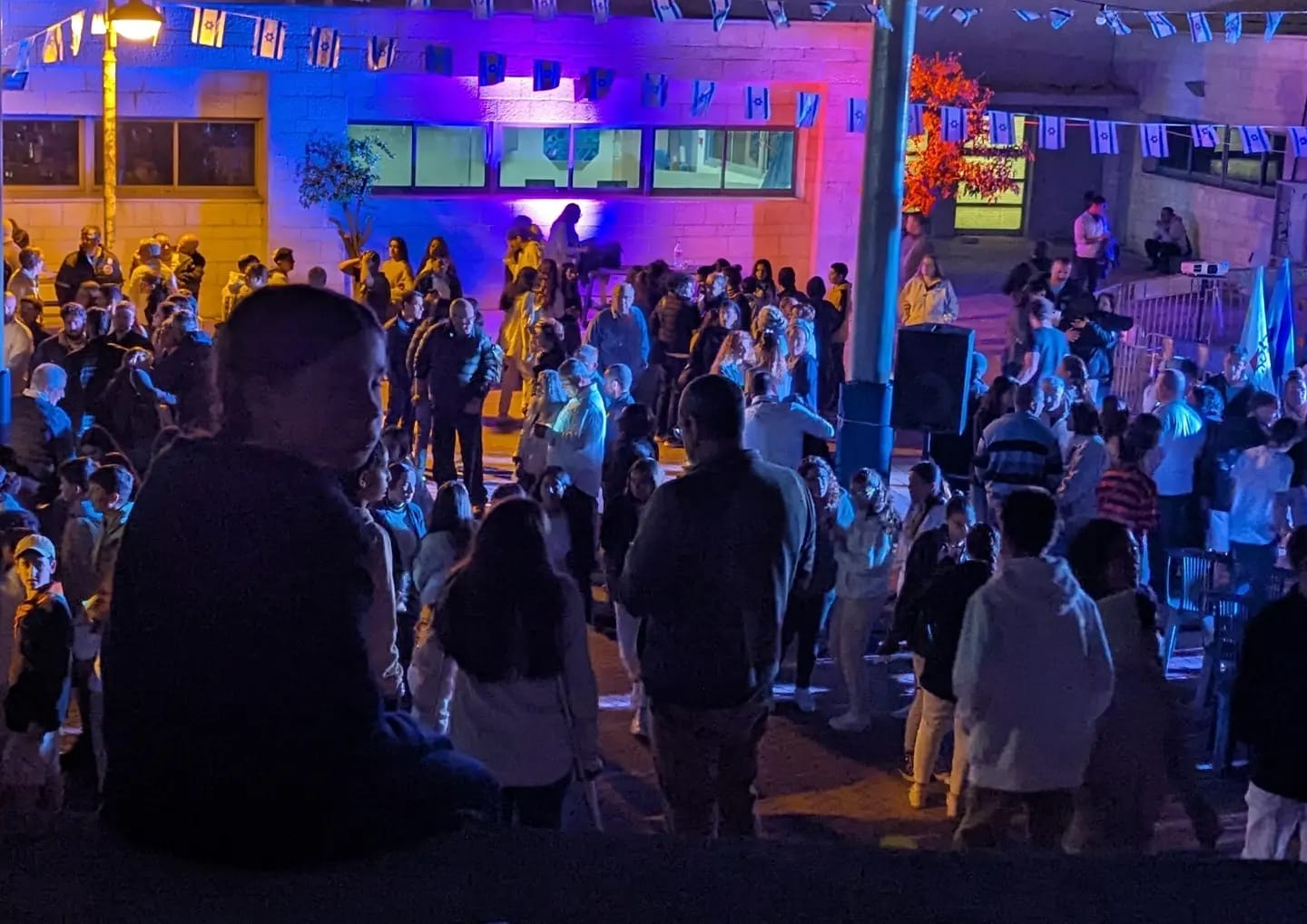
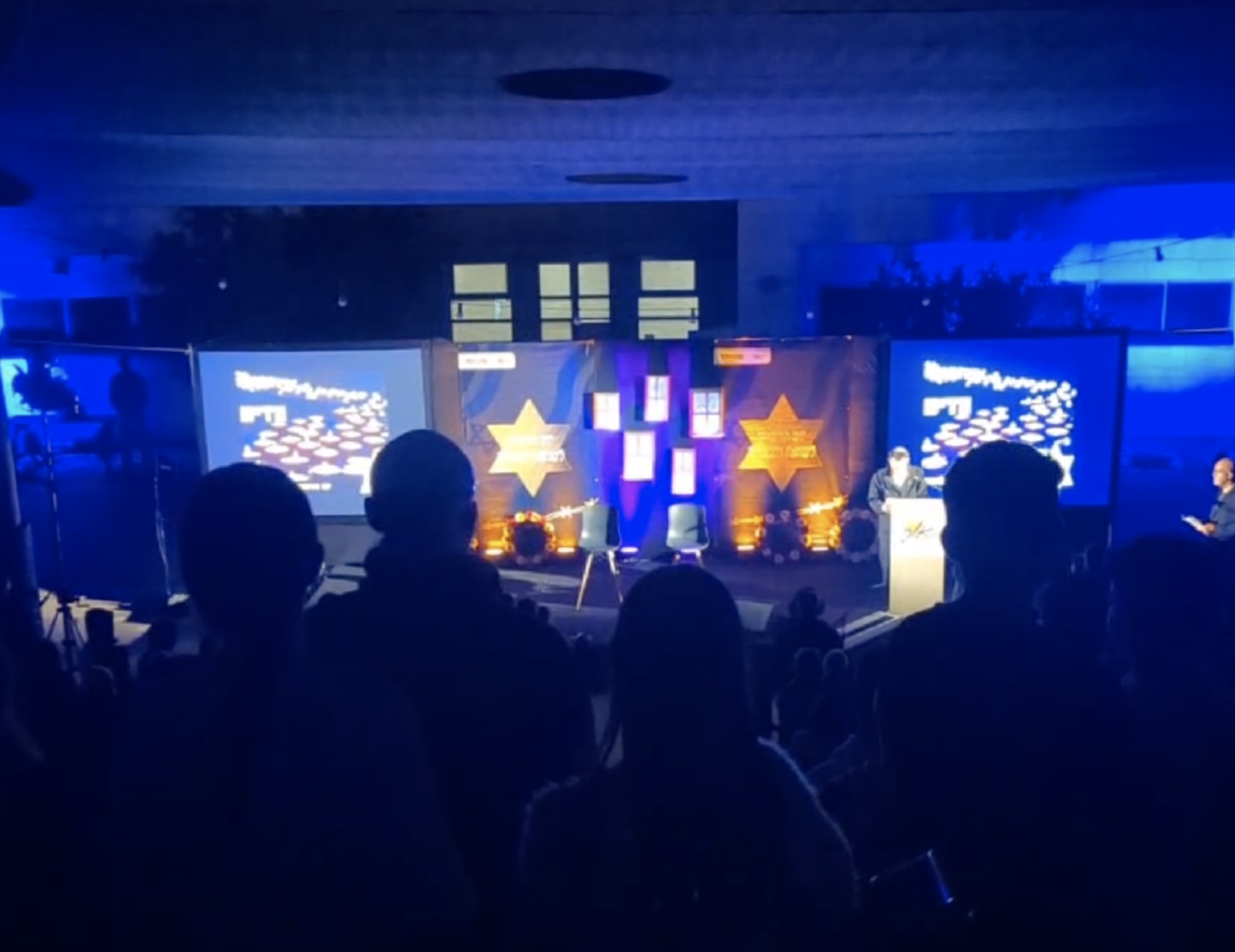
Hundreds of community members gathered in the school yard, with a small stage set up. Everyone was chatting, moving chairs, petting dogs. The MC was attempting to get everyone’s attention over the loud talking. He started to announce that in a few moments the siren would sound, would everyone turn off their phones, and please take their -

Everything stops for the Yom HaZicaron siren. Everything. Chatting, babies, dogs, microphones, MCs. This siren was really loud, the loudest I’ve ever heard it; it was also the quietest I’ve ever heard it.
There is something about a small Israeli community on Yom HaZicaron. When it is families that are surrounding you, you can feel the pain in the cracks between the crowd. They say everyone knows someone who has perished for the country - and here are the young families, remembering while moving on. A woman singing a song dedicated to her father, who died in ‘67. A boy reading a rhyme for his shevet’s madrich, who perished in Lebanon. A mother-to-be reciting a poem for her brother, who was lost this past year.
The abruptness of the stop was what jerked me into Yom HaZicaron this year. Chatting, laughing, talking, cooing - stop.
There is something about a small Israeli community on Yom HaZicaron.

May 2nd, 2008 by elie
This is the time of year when the State of Israel has a chance to really look deep into the heart of herself and understand what condition she’s in. It’s the post-Pessach triangle of introspection: yesterday was Yom HaShoah (Holocaust Remembrance Day) and next week are Yom HaZicaron (Memorial Day) and Yom Haatzmaut (Independence Day).
When I was younger, and full of the enthusiasm and energy of Herzl’s Zionism, this triangle was one of my favorite times of the year. Yom HaShoah was the day to remember why we need a state; Yom HaZicaron was the day to remember how we’ve managed to defend the state; Yom Haatzmaut was the day to celebrate how we will continue to flourish in this state.
That was, of course, before I lived in Israel.
The state of the Jewish State is bleak. Actually, it’s quite depressing. I’m tired of hearing all those wonderful accomplishments and inventions done by Israelis; It’s not moving me anymore to see pictures of young European Jews building the kibbutzim. Those are still wonderful things, to be sure. And I do get still get teary-eyed when I sing the words to Hatikvah. But pardon me if I think there are other things we need to go back to focusing on.
On Yom HaShoah I read that Holocaust survivors’ situation is worsening. I wonder why the elderly who starved under German torture are starving under the Israeli government? How are we going to continue keeping our kids’ interested in this piece of Jewish history when we can be so nonchalant towards our grandparents, who are all nearly dead? How are we going to survive ourselves?
On Yom HaZicaron I wonder what our 18-year-old soldiers are really getting killed for. Do the sirens move Ehud Omert? When he is standing with his arms behind his back, eyes low, is he thinking about the soldiers ‘ blood or border security? Is he thinking about how embarrassing it is for us to have him as a prime minister? What is the long-term plan here? How are we going to manage to stay here in Israel? Who will fight our wars in the next 20 years?
And, finally, Yom Haatzmaut this year: turning 60. I’m having a hard time understanding why this number is worth going into debt, pouring millions and millions of shekels into frivolous parties instead of working on social programs in the State’s honor to show off the good soul of the Jewish State. I’m wondering why the government is busy making sure that no one uses the Israel 60th birthday logo without permission instead of worrying over the fact that most non-immigrant Israelis I speak to are completely disenchanted with Independence Day this year. Why celebrate a lie? Why celebrate debt?
Why celebrate the state of the State of Israel this year?
March 21st, 2008 by elie
Here’s what I love about it being Purim in Israel and being a part of an Israeli community: Coming home after a seuda with new friends (including 342674 kids) and then finding Mishloach Manot at your doorstep -
I guess you could say it’s a hidden miracle that we come to Israel single and adventurous and within three years, we end up married, suburban and combating baby spit at a tea party on a Friday afternoon.
Happy Purim!
March 16th, 2008 by elie
Today I spent quite a bit of time in a Jerusalem hospital waiting room; no emergency, I just needed an x-ray. In the past few months, I’ve actually frequented Jerusalem hospital waiting rooms and have been fascinated by the faces I see and the languages I hear.
I think the true face of any city is its hospital waiting room. Conflict or none, from Belfast to Beirut, do people have much of a choice but to face each other in this neutral, undisputed territory?
Honestly, I’m not sure about those two cities, but in Jerusalem, the waiting room hosts a rainbow of Charedi Jews to secular Jews, Ashkenaz to Mizrachi, French, Russian and Ethiopian immigrants, international students and diplomats, religious and secular Arabs. You hear Hebrew spoken in so many accents, you wonder if it’s actually the same language.
Today I observed a couple of Arab women walk in with a small boy; one of the women was religious and one was not. The boy was young, maybe three, and clearly uncomfortable being there. He whined the way any child, no matter skin color nor religion, whines… The women accompanying him - the secular one seeming to be his mother - tried to hush him but to no avail.
Out of nowhere, an elderly woman came to him and started coaxing him Arabic-accented Hebrew to relax. She pulled from her bag the currency of which all children of every nation speak: crunchy snacks. She carefully poured the crackers into a cup for the boy and offered them to him: “Kach et ze, chamud. Ze b’seder. Tochel.”
Finally, the boy reached for the cup, and a chorus of Arabic flew from his mother and her companion: “Say thank you! Thank you! Shukran! Say shukran!” The older woman, who I realized was Mizrachi, spoke softly to the boy: “Yofee… Tochel, yeled tov. Tagid todah. To-dah. Tagid todah…”
This chorus of shukrans and todahs was not stopping, and soon I found that the Arab women were telling the boy to “Tagid todah,” while the Jewish woman was encouraging him to say “shukran!”
Language, faces, hospitals, kids, snacks. All undisputed territory when they work together.
March 7th, 2008 by elie
Merkaz HaRav, the yeshiva chosen by the Arab gunman for last night’s massacre, is a flagship yeshiva that stands at the heart of the Religious Zionist movement and should not be confused with the extreme anti-Israel strain of yeshiva population. One Merkaz HaRav student shot the gunman twice in the head with a pistol he had at his side; I assume they are very realistic about the situation in Israel.
But it makes me wonder about the yeshivas that are anti-Israel; that yeshiva boys can dodge the army all they want, but as long as Jews live in this land, they will be involved in the blood that is spilled over it. Whatever their politics. So it works both ways, for peace-loving secularists and for Israel-hating Charedis. I wonder how the Charedi community - the anti-Israel one - is working this out.
“It’s the secularists fault for not studying Torah.”
“It’s because Mashiach is not here yet, this country is impure.”
“More proof that Arabs are animals, sent by God to destroy us for our sins.”
Just my own speculation. And it’s certainly not close to all Charedis Jews - that would be a very unfair and unrealistic generalization… I do think it is a bit eerie that just yesterday Barak refused to exempt 1,000 yeshiva students from army service.
All I know is that from thousands of years ago to yesterday to tomorrow… whether the yeshiva community likes it or not… blood and books are an inevitable mix.
(ynet)
They released the names of the 8 boys killed:
Yohai Lifshitz, 18, of Jerusalem
Yehonatan Yitzhak Alder, 16, of Shilo
Yonadav Haim Hirshfeld, 19, of Kochav Hashahar
Neria Cohen, 15, of Jerusalem
Roy Rot, 18, of Elkana
Segev Peniel Avihail, 15, of Neveh Daniel
Avraham David Mozes, 16, of Efrat
Maharta Tronoh, 26, of Ashdod
Keep their memory in our prayers, along with the dozens wounded.